
What are Oxalates?
Oxalates are naturally occurring compounds in plants that serve several essential survival functions. They act as a defense mechanism against herbivores, regulate internal calcium levels, detoxify heavy metals, and aid in light capture for photosynthesis
Why do we care about oxalates?
- kidney stones
- block absorption of calcium and other minerals
Should foods containing oxalates be avoided?
This information is geared towards people with osteopenia/osteoporosis. if you are also prone to kidney stones, it is essential that you consult with your health care provider.
Unless advised otherwise by a healthcare provider, oxalates are fine in moderation. Although they do not provide any known health benefit to humans, oxalates are found in foods that are rich in many valuable nutrients:
- anti-oxidants: compounds that help prevent cells from damage from free radicals
- essential nutrients
- minerals
- vitamins
- dietary fiber
There are just a few foods that contain so much oxalate that they will prevent any calcium in your meal from being absorbed. 100 g corresponds to approximately 3 1/2 oz.
- spinach: 600 - 700 mg/100 g of raw spinach; 750 - 900 mg per cup of cooked spinach
- swiss chard: 870 - 1450 mg/100 g [3 1/2 oz] raw swiss chard; 600 - 700 mg per cup of cooked swiss chard
- rhubarb stems: 1235 mg/ 100 g
- beet greens and beets: 500 - 600 mg per cup of cooked beet greens
- sorrel: >500 mg per cup
Other than the foods listed above, you just need to calculate how much calcium is blocked from absorption by the oxalates. Once you have determined how much oxalate is in your meal (see below), you can use this rule of thumb to calculate the maximum amount of calcium that is blocked: Divide the mg of oxalate by 2 to get the mg of calcium that potentially is not absorbed. This is based on the molecular weight of oxalate (88 g/mole) vs calcium ion (40 g/mole). Each mole of oxalate can bind up to 1 mole of calcium ion.
Soluble vs Insoluble Oxalates
Soluble oxalates are oxalates that are complexed with sodium, potassium or ammonium (monovalent cations). These complexes readily dissociate in the stomach, releasing the oxalate for absorption. A portion of the soluble oxalate in food can be released by boiling the food and discarding the water.
Insoluble oxalates are oxalates that are complexed with calcium, magnesium, or iron (or other divalent cations). These complexes do not readily dissocate in the stomach, and are more likely to pass through the intestines unabsorbed and be excreted in the feces.
Taking calcium (either as food or supplement) with food containing oxalates helps to convert the soluble oxalate into insoluble oxalate.
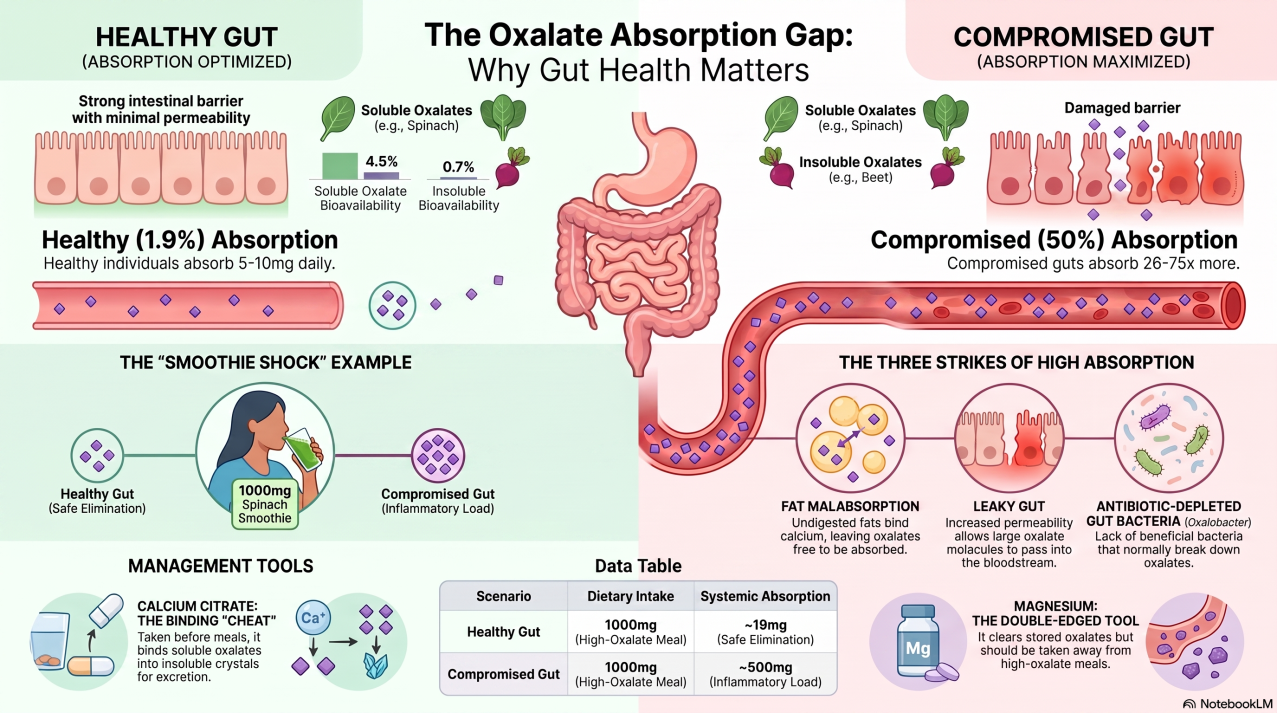
This is a very complex subject. For an in-depth discussion, see "Soluble vs Insoluble Oxalates: What’s the Difference?" by Marek Doyle. This article probably dates to 2017. It is worth reading the comments at the end of the article as there are some very good questions and many of the replies contain references to additional articles. Check out the Oxalate calculator under resources at Marek's website. An important take-home message from the article is that people with poor gall bladder function or with compromised guts (e.g. leaky gut), will absorb considerable more oxalate than a person with an intact gastrointestinal system. See sbove.
Boiling food with a high content of soluble oxalate helps to remove a significant portion of the soluble oxalate (as long as the water is thrown out). Steaming is less effective.
Caution: Do not suddenly reduce the your consumption of oxalates. Tapering oxalate consumption gradually—typically by 5–10% per week—is highly recommended to prevent "oxalate dumping" (the rapid release of stored oxalates from tissues) and minimize the risk of kidney stones (see Healthline for more info)
According to the Oxalosis & Hyperoxaluria Foundation, a low oxalate diet is under 100 mg/day. A severely restricted diet would be less than 50 mg/day.
References for oxalate content of various foods
These references provide actual oxalate content of various foods. Focus more on the numbers and less on the categories - "high oxalate" covers a very broad range, and each individual has different limits depending on other health conditions (such as whether they are prone to kidney stones). Goals should be set with your healthcare provider.
- Marek Doyle's calculator (web based)
- Univ. of California - Irvine Kidney Stone Center
- St. Joseph's Healthcare/Hamilton
- Oxalosis & Hyperoxaluria Foundation
Apps
- OxiPur (only available on Apple devices): provides information about oxalate content and purine content (relevant for people prone to gout) of food
- Cronometer (available as an app and via web browser): generally helpful nutrition tracker. Has oxalate content of many foods, but be careful of any grain/fruit/vegetable that shows 0 - this may mean a lack of testing rather than actual lack of oxalate.